


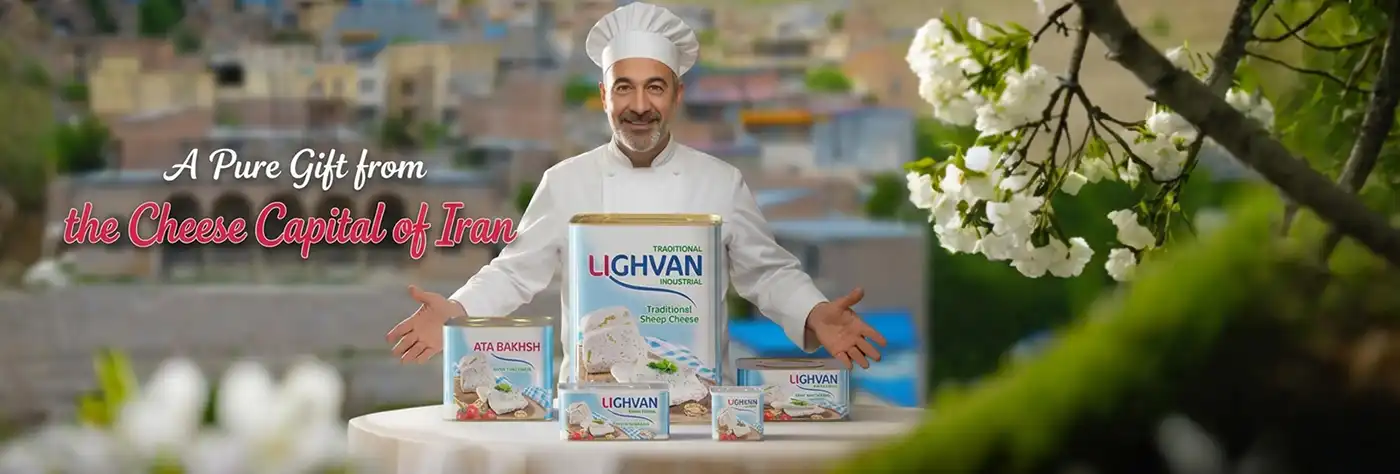



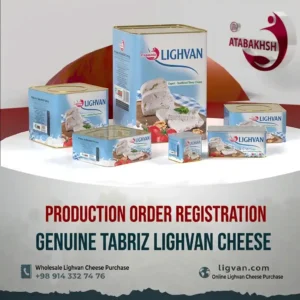
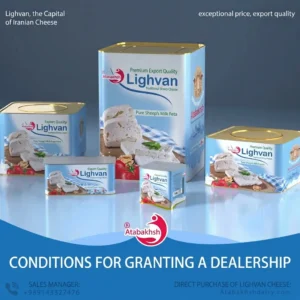
Lighvan Cheese – 400g
- Product Type: Premium Export-Grade Sheep Cheese
- Low-salt, odorless, top-quality (Grade A)
- Metal can with easy-open lid
- Plastic overcap to preserve freshness
- 100% Organic Production – International Standards
- Net Weight: 400g
- Package Weight: 600g (includes 200g brine and container)
- Shelf Life: 12 months
- 18 cans per carton
- Ideal for small families
- Perfect for corporate gift packages
- Storage: Refrigerate at 2–4°C in original brine

Lighvan Cheese – 800g
- Product type: Premium Sheep – Export Quality
- Low-salt, Odorless, Top Quality (Grade A)
- Metal packaging with easy-open lid
- Plastic cover to preserve product quality
- Fully organic production with international standards
- Net weight: 800 g
- Shelf life: 12 months
- 12 cans per carton
- Ideal option for corporate and organization gift baskets
- Storage: In refrigerator at 2–4°C in its own brine

Lighvan Cheese – 2kg
- Product Type: Premium Export-Grade Sheep Milk Cheese
- Low-Salt, Odorless, Top Quality (Grade A)
- Packaging: Metal Tin
- Fully Organic Production with International Standards
- Net Weight: 2 kg
- Shelf Life: 12 Months
- 3 Tins per Carton
- Storage: Refrigerate at 2-4°C in its own whey
- Usage: Large Families – Family Gatherings, Heavy Consumers of Lighvan Cheese, Restaurants, Cafés

Lighvan Cheese – 3kg
- Product Type: Premium Export-Grade Sheep Milk Cheese
- Low-Salt, Odorless, Top Quality (Grade A)
- Packaging: Metal Tin
- Fully Organic Production with International Standards
- Net Weight: 3 kg
- Shelf Life: 12 Months
- 2 Tins per Carton
- Storage: Refrigerate at 2-4°C in its own whey
- Usage: Large Families – Family Gatherings, Heavy Consumers of Lighvan Cheese, Restaurants, Cafés

Lighvan Cheese – 5kg
- Product Type: Premium Sheep Cheese – Export Grade
- Low-salt, odorless, top quality (Grade A)
- Packed in metal tins
- 100% organic production with international standards
- Net Weight: 4.5 kg
- Shelf Life: 12 months
- 2 tins per carton
- Storage: Refrigerate at 2–4°C in its natural whey
- Usage: Large gatherings, Liqvan cheese lovers, restaurants, cafés

Lighvan Cheese – 17kg
- Product Type: Premium Export-Grade Sheep Cheese
- Low-Salt, Odor-Free, Exceptional Quality (Grade A)
- Durable Metal Can Packaging
- 100% Organic Production Meeting International Standards
- Net Weight: 14 kg
- Shelf Life: 12 Months
- 1 Can per Master Carton
- Storage: Keep Refrigerated at 2–4°C in Its Original Brine
- Ideal For: Banquet Halls, Specialty Dairy Shops, Grocery Stores, Restaurants, and Cafés


What is Lighvan Cheese?
What Is Lighvan Cheese?
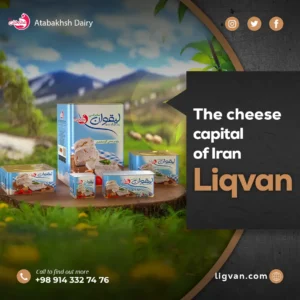
To accurately answer the question, “What is Lighvan cheese?”, we need to go beyond the simple definition of a dairy product and examine it as a geographic-biological phenomenon. In its purest definition, Lighvan cheese is a semi-hard cheese made exclusively from whole, raw sheep’s milk from Qezel sheep raised in Lighvan village and the surrounding areas on the northern slopes of Mount Sahand. The cheese is preserved in saturated brine and undergoes its aging process in natural and hand-carved caves deep within the mountains.
What distinguishes the answer to the question “What is Lighvan cheese?” is the vital role of the region’s “terroir,” or environmental characteristics. The vegetation on the slopes of Sahand, which includes hundreds of aromatic and medicinal plant species such as mountain thyme, pennyroyal, and tragacanth, forms the animals’ diet. The aromatic compounds of these plants are transferred directly into the milk, creating a complex flavor profile in the finished cheese that cannot be replicated with industrial additives.
What Is Sheep’s Cheese?
To understand the value of Atabakhsh products, we must first understand what sheep’s cheese is and why it has earned the title of “white gold” among different types of cheese. Sheep’s cheese is a product made from ewe’s milk. Unlike cattle, sheep are much less suited to intensive industrial farming and feeding with artificial concentrates. Qezel sheep, which provide the milk used for Lighvan cheese, are pasture-raised animals that graze freely in nature for most of the year. Therefore, when we ask, “What is sheep’s cheese?”, we are essentially talking about an extract of nature. Sheep’s milk is thicker than cow’s milk and contains more total solids. This means that producing one kilogram of cheese requires less sheep’s milk (approximately 3–4 kg) than cow’s milk (approximately 7–9 kg), although sheep’s milk itself is considerably more expensive and less readily available.
From a biochemical perspective, answering the question “What is sheep’s cheese?” involves structural differences in fat and protein. Fat globules in sheep’s milk are smaller than those in cow’s milk, which contributes to easier digestion and a creamier cheese texture. Sheep’s milk also contains higher amounts of short- and medium-chain fatty acids, such as caprylic acid and capric acid, which are responsible for the distinctive, sharp aroma and flavor of sheep’s cheese.
These fatty acids are not only flavor compounds but are also associated with health-related properties. At Atabakhsh, we believe that when a customer asks what sheep’s cheese is, we should offer a product that preserves these biochemical characteristics at the highest possible level.
In addition, when discussing sheep’s cheese, its seasonal nature should be considered. Sheep produce milk only during a specific period of the year, mainly spring and early summer, and enter a dry period during the colder months. This seasonal limitation makes authentic sheep’s cheese a rare and valuable product. Unlike industrial cheeses, which are produced throughout the year with relatively uniform and often lower quality, Atabakhsh sheep’s cheese is a living product whose aroma and flavor can vary subtly depending on the plants the animals have consumed during a particular month. This vintage-like characteristic is one of the main attractions of sheep’s cheese for connoisseurs.
Types of Lighvan Cheese
The Lighvan cheese market offers a wide range of products, and understanding the different types of Lighvan cheese helps customers make choices according to their preferences and budget. Broadly speaking, Lighvan cheese can be divided into three main categories based on milk quality and production period: Super Lighvan cheese, regular Lighvan cheese, and Lighvan-style cheeses. Super Lighvan, the flagship product of the Atabakhsh brand, is made from pure sheep’s milk collected during the peak of spring (May and June). During this period, fresh pasture is abundant, and the milk has its highest fat content and richest aroma. This cheese has an exceptionally soft texture, large and evenly distributed holes, and an outstanding flavor.
The second category among the types of Lighvan cheese is regular Lighvan cheese. This product is also made from sheep’s milk, but it may come from the later part of the lactation season, when the milk’s fat content has declined slightly, or its production and aging conditions may not have reached the ideal standards of Super Lighvan cheese. It still offers very high quality, but its texture may be slightly firmer and its holes smaller. This type of cheese is somewhat more affordable than Super Lighvan and is an excellent choice for everyday consumption. Atabakhsh clearly communicates these quality differences through its packaging so customers know exactly what they are purchasing.
The third category, which should be approached with caution, consists of cheeses sometimes sold as Lighvan cheese but actually made as Tabriz cheese or blended cheeses. Some producers mix sheep’s milk with cow’s or goat’s milk to reduce production costs. Although these cheeses can also be flavorful, they do not have the authenticity or the distinctive therapeutic and sensory characteristics of pure Lighvan cheese. Another classification of Lighvan cheese is based on packaging, including 17-kg metal tins, smaller tins, vacuum packaging, and other formats, each designed for specific applications such as wholesale, retail, and supermarket sales.
Difference Between Sheep’s Cheese and Cow’s Cheese
Understanding the difference between sheep’s cheese and cow’s cheese from the perspectives of traditional medicine and modern nutrition can help consumers make informed dietary choices. In traditional Iranian medicine, the difference between sheep’s cheese and cow’s cheese is associated with their “temperament.” Cow’s milk and cheese are generally considered to have a “cold and moist” temperament, and excessive consumption, particularly by people with a naturally cold temperament or during cold seasons, is traditionally believed to contribute to weakness, lethargy, and joint pain. Sheep’s cheese, by contrast, is considered “warmer” and more energizing because of its higher fat content and greater concentration. Atabakhsh Lighvan cheese, which undergoes complete fermentation and is combined with salt, is considered more balanced and may serve as a dietary complement, making it easier to digest for sensitive stomachs.
From the perspective of modern nutritional science, the difference between sheep’s cheese and cow’s cheese lies in their nutritional profiles. Sheep’s milk contains approximately twice as much protein as cow’s milk and is a richer source of calcium, phosphorus, zinc, and B vitamins, particularly B12. One important aspect of the difference between sheep’s cheese and cow’s cheese concerns the type of beta-casein protein they contain. Many sheep breeds naturally produce A2-type milk, which is claimed to be easier to digest, whereas milk from industrial cattle often contains A1 protein, which may contribute to inflammation or digestive discomfort. Therefore, for people who experience bloating or digestive problems after consuming cow’s dairy products, Atabakhsh sheep’s cheese may provide an enjoyable alternative.
Another aspect of the difference between sheep’s cheese and cow’s cheese is flavor and texture. Sheep’s milk fat contains higher levels of volatile fatty acids, which contribute to the distinctive, sharp flavor of Lighvan cheese. Sheep’s cheese is characteristically chalky white because sheep convert beta-carotene, the yellow pigment found in plants, into vitamin A, leaving little pigment to enter the milk. Cow’s milk, however, contains beta-carotene, which gives cow’s milk and the resulting cheese a yellowish or creamy color. Atabakhsh emphasizes this difference between sheep’s cheese and cow’s cheese and helps customers understand that a pure white appearance is one of the notable visual characteristics associated with sheep’s cheese.
Authentic Lighvan Cheese Is Made from Sheep’s Milk, Not Cow’s Milk
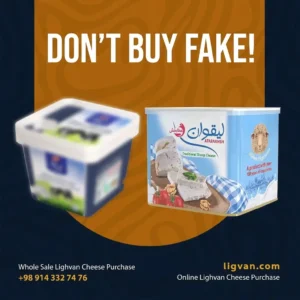
This is not merely an advertising slogan but a fundamental principle of the product’s identity: authentic Lighvan cheese is made from sheep’s milk, not cow’s milk. In recent years, increasing demand and limited sheep’s milk production have led some producers to introduce cow’s milk into the production process and sell the resulting product under the Lighvan name. Informed customers should understand that authentic Lighvan cheese is made from sheep’s milk, not cow’s milk, and that mixing it with cow’s milk changes the nature of the product. Cow’s milk has a different protein structure, which can produce a firmer and more rubbery cheese, lacking the characteristic softness and delicacy of Lighvan cheese that melts in the mouth.
Why do we emphasize that authentic Lighvan cheese is made from sheep’s milk, not cow’s milk? Because the Lighvan ecosystem is based on sheep grazing in the highlands of Sahand. Cattle cannot easily climb the rugged highlands or feed on the distinctive plants found in those areas. Therefore, cow’s milk used in the region is generally sourced from dairy farms where animals are fed manually supplied forage and does not carry the aroma and flavor of mountain plants. When we say that authentic Lighvan cheese is made from sheep’s milk, not cow’s milk, we are essentially protecting the taste of the terroir. Atabakhsh conducts periodic testing and carefully monitors incoming milk to ensure that not even a drop of cow’s milk enters the production cycle of its premium Lighvan cheeses.
Consumers can look for several simple indicators when trying to determine whether Lighvan cheese is genuinely made from sheep’s milk rather than cow’s milk. First is color: as mentioned above, sheep’s cheese is typically matte, icy white, while cow’s cheese tends to have a yellowish undertone, unless it has been chemically whitened, in which case it may appear unnaturally glossy. Second is flavor: sheep’s cheese has a rich, fatty, slightly sharp flavor resulting from the distinctive fatty acids in sheep’s milk, whereas cow’s cheese generally has a milder, more milky flavor. Third is price: given the considerably higher price of sheep’s milk, an unusually low-priced cheese marketed as Lighvan may warrant scrutiny. Atabakhsh highlights the authenticity of its products through transparent pricing.
Difference Between Lighvan Cheese and Tabriz Cheese
In the market, the names Lighvan and Tabriz are often heard together, but the difference between Lighvan cheese and Tabriz cheese is substantial. Tabriz cheese, sometimes also known as Qoozeh cheese or traditional Azerbaijani cheese, is a popular and high-quality Iranian cheese, but its ingredients and production method differ from those of Lighvan cheese. The primary difference between Lighvan cheese and Tabriz cheese is the type of milk used. Lighvan cheese is made exclusively from sheep’s milk, while Tabriz cheese is generally made from cow’s milk or a mixture of cow’s and sheep’s milk. This difference in milk results in different physical structures: Lighvan cheese is soft, crumbly, and rich in fat, whereas Tabriz cheese is firmer, drier, and easier to cut cleanly without excessive crumbling.
Another important difference between Lighvan cheese and Tabriz cheese lies in the aging process. Both cheeses are preserved in brine, but Lighvan cheese requires aging in naturally cool and humid caves to allow specific bacteria associated with sheep’s milk to become active, producing its characteristic large holes and sharp flavor. Tabriz cheese may be aged in workshops or industrial cold-storage facilities, with fermentation controlled to create a sharp flavor that differs from Lighvan. In terms of taste, Tabriz cheese is generally perceived as saltier and sharper, but it lacks the background aroma of animal butter and mountain plants found in Lighvan cheese.
The difference between Lighvan cheese and Tabriz cheese can also be observed visually. Tabriz cheese generally has fewer and smaller holes and tends to have a slightly yellowish color due to the use of cow’s milk. Lighvan cheese, on the other hand, has larger, irregular holes and a pure white color. In terms of price, Lighvan cheese is generally more expensive than Tabriz cheese because sheep’s milk is more costly and production is more demanding. Atabakhsh offers both types of cheese in its product range, while clearly separating and labeling them so customers can understand the difference between Lighvan and Tabriz cheese and avoid purchasing cow’s cheese when they are looking for sheep’s cheese.
What Are the Characteristics of Authentic Tabriz Lighvan Cheese?
For professional buyers, knowing the characteristics of authentic Tabriz Lighvan cheese is key to identifying a high-quality product. The first characteristic is “texture and cuttability.” Because authentic Lighvan cheese does not contain artificial preservatives and has a high fat content, it has a soft texture. When you insert a knife and cut it, the cheese should neither resist like rubber nor be dry like chalk. Instead, it should be soft and crumble slightly as the slice separates, creating what is known as a crumbly texture. This slight crumbling is not a defect; rather, it is one of the characteristics associated with authentic Lighvan cheese and may indicate that firming commercial starter cultures have not been used.
The second characteristic concerns the “holes” in the cheese. These holes, which result from the cheese’s natural activity during the months of aging in the caves, should generally be around the size of a pea or bean and have irregular shapes. Very small, pin-like holes or perfectly round and uniform holes can often indicate industrial production or the use of processed pasteurized milk. In Atabakhsh cheese, these openings are distributed consistently throughout the cheese, indicating uniform and standardized fermentation.
The third, and perhaps most important, characteristic when identifying authentic Tabriz Lighvan cheese is its “taste and aroma.” Authentic cheese should not smell sour, moldy, or strongly “sheepy” in an unpleasant barn-like way. Its aroma should combine a mild scent of fresh milk with a pleasant fermented note. Its flavor should balance saltiness and fat; it should not be so salty that it burns the throat, which may indicate excessive aging or an attempt to mask poor-quality milk, while its fat should feel buttery in the mouth. Atabakhsh carefully controls brine salinity and storage conditions to provide a product that meets these characteristics.
What Is the Difference Between Tin and Plastic Lighvan Cheese Packaging?
Packaging helps preserve cheese quality, and understanding the difference between tin and plastic Lighvan cheese packaging is important when choosing how to store and purchase the product. The traditional and authentic packaging for Lighvan cheese is metal tins. Metal prevents light penetration and provides thermal characteristics that are suitable for continued cheese aging in cold storage or refrigeration. In metal tins, the cheese is kept in a completely dark environment and submerged in brine, helping preserve freshness and preventing the cheese fat from oxidizing and developing a strong off-odor. When considering the difference between tin and plastic Lighvan cheese packaging, 17-kg tins and even smaller tins, such as 800-g packages, are excellent options for people who want to store cheese for longer periods.
Plastic packaging and IML containers, which have become increasingly common, offer different advantages. The main difference between tin and plastic Lighvan cheese packaging is convenience and product visibility. Transparent or semi-transparent plastic containers allow customers to see the cheese’s texture and color before purchasing. These containers are also lighter, and their lids are generally easy to open and can be resealed. However, low-quality conventional plastics may react with lactic acid and the salt in cheese over the long term, potentially creating unpleasant flavors or allowing light to penetrate and reduce cheese quality.
Atabakhsh responds to customers asking about the difference between tin and plastic Lighvan cheese packaging by offering both options at high quality. Atabakhsh metal tins are coated internally with food-grade material to prevent corrosion. Meanwhile, Atabakhsh plastic packaging is made from multilayer polymer materials resistant to oxygen penetration, helping bring the cheese’s shelf life as close as possible to that of tin packaging. Plastic packaging is suitable for short-term use and convenience, while metal tins remain unmatched for a nostalgic, authentic experience and bulk purchasing.
Premium Lighvan Cheese Price
Determining the price of premium Lighvan cheese is a complex process influenced by economic and seasonal variables. This product is not an industrial commodity with a fixed factory price; rather, it is an agricultural and livestock product. The most important factor affecting the price of premium Lighvan cheese is the current price of sheep’s milk. Sheep’s milk is a valuable and scarce raw material whose price is several times higher than cow’s milk. Fluctuations in livestock input costs, including forage and barley, labor costs, and weather conditions such as drought or wet years, directly affect the cost of milk and ultimately the price of cheese. Atabakhsh premium cheese, made from the highest-quality milk, naturally falls into the premium price category.
Another factor affecting the price of premium Lighvan cheese is the milk-to-cheese conversion ratio and the time during which capital remains tied up. Producing one kilogram of premium Lighvan cheese requires approximately 3–3.5 kilograms of concentrated sheep’s milk. In addition to raw-material costs, the cost of tied-up capital is significant because the producer must pay expenses in spring while the finished product is sold in autumn and winter after 3–6 months of aging and storage. Cold storage, labor, packaging, and transportation costs are also added to the final price. Therefore, when discussing the price of premium Lighvan cheese, customers are effectively paying for a long and labor-intensive production process.
In the retail market, the price of premium Lighvan cheese may vary. Small packages, such as 400-g and 800-g containers, have a higher unit price than bulk purchases because of higher packaging and distribution costs. Retail intermediaries may also add their margins. Atabakhsh seeks to keep the price of premium Lighvan cheese at a reasonable level through direct distribution and by eliminating unnecessary intermediaries, allowing more consumers to access this high-quality product. Customers should be aware that unusually low prices are often a warning sign of inferior quality or counterfeit products.
17-Kg Lighvan Cheese Price
For wholesalers, traditional restaurants, hotels, and large families, knowing the price of 17-kg Lighvan cheese is particularly important because this packaging format is one of the most economical ways to purchase authentic cheese. The tins commonly referred to as 17-kg tins are, in fact, a traditional standard in the wholesale market. Buyers should note that the net cheese weight (drained weight) in these tins generally varies between 13.5 and 15 kg, while the remaining weight consists of brine and the metal tin itself. Therefore, when comparing the price of 17-kg Lighvan cheese, the price should always be calculated based on the net cheese weight rather than the total weight of the tin.
The price of 17-kg Lighvan cheese in the wholesale market fluctuates seasonally. During the production season, mainly spring and early summer, when the supply of milk is high, prices may be more stable. As autumn and winter approach and warehouse inventories decline, prices may trend upward. In the current year, the price of a 17-kg tin of authentic sheep’s Lighvan cheese has varied depending on brand and quality level (Super, Premium, or Regular), for example, from approximately 7 million to more than 9 million tomans. Atabakhsh manages its inventory and storage facilities to reduce sharp fluctuations in the price of 17-kg Lighvan cheese and ensure stable supply for wholesale customers.
Buying a 17-kg tin offers advantages beyond price. Because of the large volume of brine and the isolated environment, the cheese can maintain its quality for months and may even become more mature and flavorful over time. For dairy shops that sell cheese by the kilogram and in bulk, the price of Atabakhsh 17-kg Lighvan cheese can provide a suitable profit margin, while the product’s high quality can help build customer loyalty. Purchasing directly from the Atabakhsh sales office or authorized representatives in major markets is presented as a way to obtain competitive pricing and greater assurance of product authenticity.
Lighvan Cheese Price in Tehran
As Iran’s largest consumer market, Tehran is a major influence on market prices, and the price of Lighvan cheese in Tehran is often used as a reference for other cities. Tehran’s cheese market is concentrated in areas such as Molavi Market, Mohammadieh Square (Khayyam), and Anbar-e Naft. In these centers, Lighvan cheese prices are determined daily based on supply and demand. Transportation costs from Tabriz to Tehran, cold-storage costs around Tehran, and distribution expenses all affect the final price. Prices in these wholesale centers generally serve as references for supermarkets and dairy shops throughout the city.
In addition to the traditional market, the price of Lighvan cheese in Tehran can vary significantly between different parts of the city and different types of stores. In chain stores and hypermarkets, which have higher overhead costs, small packages may be more expensive than at local dairy shops that open tins and sell cheese in bulk. Atabakhsh, with its extensive distribution network in Tehran, seeks to minimize the price gap between the factory and the final consumer. Offering online purchasing and direct home delivery in Tehran is another strategy used by Atabakhsh to provide competitive prices and eliminate unnecessary intermediaries.
Wholesale buyers in Tehran should note that the price of Lighvan cheese may differ between “fresh” batches, which are softer and less salty, and “aged” batches, which are more mature and sharper in flavor. Aged batches are generally more expensive because they lose more weight during storage. Established brands such as Atabakhsh, which hold health permits and the Iranian Health Mark, may also have slightly higher prices than unbranded cheeses sold without official certification. In the Tehran market, competition is high, and Atabakhsh positions its products around quality assurance.
Lighvan Cheese Price on Digikala
In the age of e-commerce, checking Lighvan cheese prices on Digikala and other online marketplaces has become one of the main ways consumers discover market prices. Digikala provides a transparent marketplace where customers can compare prices across different brands. The presence of Atabakhsh and other established brands on the platform allows customers to stay informed about price changes without visiting physical markets. The price of Lighvan cheese on Digikala generally includes the product price plus platform commissions and processing and packaging costs, so it may differ slightly from wholesale market prices. However, the convenience of online shopping can justify this difference.
One important point when analyzing Lighvan cheese prices on Digikala is to pay attention to customer reviews and product ratings. Some lower-priced products on such platforms may receive comments about excessive saltiness, being crushed or damaged, or having an unpleasant taste. Atabakhsh, by maintaining its premium quality, aims to provide high customer satisfaction and good value for money for online buyers. Periodic discounts and special offers can also make Lighvan cheese prices on Digikala particularly attractive to shoppers.
For informed shoppers, it is also advisable to compare Lighvan cheese prices on Digikala with the official Atabakhsh online store. Purchasing directly from the producer may sometimes come with special discounts and fresher delivery. At the same time, Digikala provides valuable access to the product for consumers in more remote parts of Iran who may have limited access to authentic Lighvan cheese, making its prices a useful reference for final consumer prices nationwide.
Nutritional Value and Feature Comparison of Lighvan Cheese
| Feature | Authentic Lighvan Cheese (Sheep’s Milk) – Atabakhsh | Tabriz Cheese (Cow’s Milk/Blended) | Industrial White Cheese |
| Primary Ingredient | Pure Qezel sheep’s milk | Cow’s milk or a blend | Milk powder and cow’s milk |
| Color | Uniform matte white | Yellowish or creamy | Glossy white (unnatural) |
| Texture | Soft, crumbly, with irregular holes | Firmer, sliceable, with small holes | Rubbery, uniform, without holes |
| Flavor | Sharp, fatty, aromatic (herbal), umami | Salty, sharp, cooked-milk flavor | Mild, bland, or additive-like flavor |
| Traditional Temperament | Warm and balanced (energizing) | Cold and moist | Cold |
| Protein | Very high (A2 casein) | Moderate (A1 casein) | Moderate to low |
| Price | High (premium) | Moderate | Low |
| Shelf Life | Long in brine (months) | Moderate | Limited after opening |
This table was compiled based on analytical data comparing the products.